
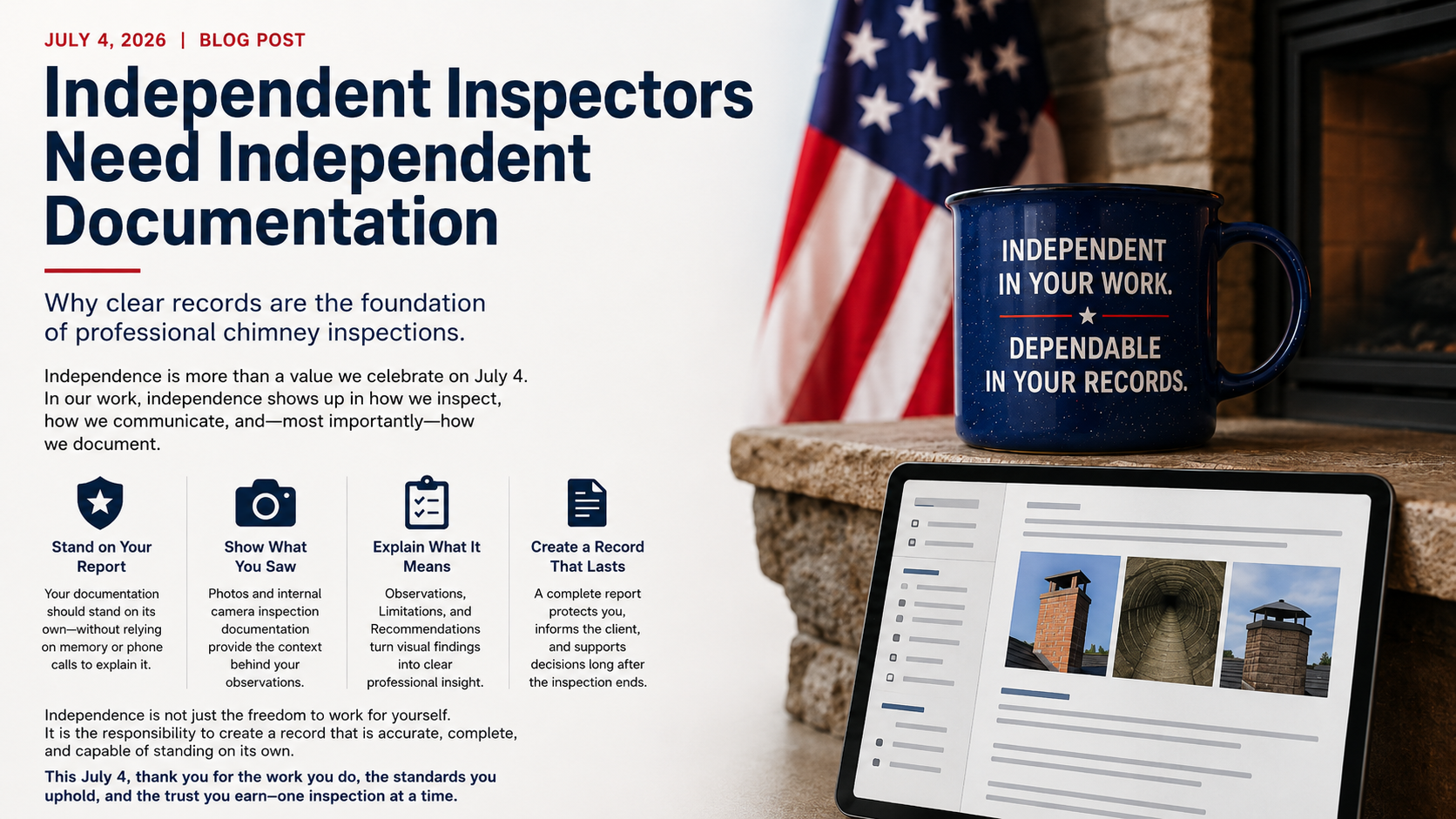
Independence is not only a value we celebrate on July 4.
In professional inspection work, independence also shows up in the record we create.
A chimney inspection report should not depend on the inspector being available later to explain what they meant. It should not depend on memory, a phone call, a verbal summary, a text thread, or an office reviewer trying to reconstruct the inspection from loose photos.
The report should stand on its own.
That does not mean the report answers every possible question. It does not mean every concealed condition was visible. It does not mean the inspector guarantees future performance. It does not mean software replaces training, standards, or professional judgment.
It means the report should clearly explain the inspection that was actually performed.
That distinction matters.
A Report Should Stand Without the Inspector in the Room
A professional chimney inspection report may be read long after the appointment is over.
It may be reviewed by:
- the homeowner;
- a buyer or seller;
- a Realtor;
- a property manager;
- a contractor;
- an insurance adjuster;
- an AHJ;
- an attorney;
- another inspector;
- a future technician;
- the company office.
That reader may not have been present during the inspection.
They may not know what the inspector saw, what was limited, what was excluded, what was inaccessible, or why a recommendation was made.
The report has to preserve that context.
If the report only says “chimney needs repair,” the reader is left guessing.
If the report says which system was inspected, what was observed, what evidence supports the Observation, what Limitation affected the inspection, and what Recommendation follows, the report becomes more useful.
The goal is not longer reports.
The goal is clearer records.
Independence Requires Scope
A report that stands on its own begins with scope.
The reader should be able to understand:
- what system was inspected;
- what type of inspection was performed;
- why the inspection was performed;
- which areas were included;
- which areas were excluded;
- which areas were inaccessible;
- which areas were limited;
- which sections were Not Applicable;
- which sections had Nothing to Report;
- which Observations required Recommendations.
Without scope, the report can imply more than the inspector actually did.
That is especially important in chimney, fireplace, venting, and appliance inspections because much of the system may be concealed, inaccessible, or dependent on manufacturer instructions, listing information, or internal camera inspection.
A report that does not identify scope may appear stronger than it is.
A report that clearly documents scope is more professionally honest.
“Nothing to Report” Must Mean Something
Nothing to Report is useful language only when it is used carefully.
It should mean:
The section was included and observed within the applicable scope, and no reportable Observed Condition was documented.
It should not mean:
- skipped;
- forgotten;
- inaccessible;
- excluded;
- outside the agreed scope;
- hidden by construction;
- unsafe to access;
- not applicable;
- not inspected.
That distinction is part of independent documentation.
A future reader should be able to tell whether a section was actually observed and had Nothing to Report, or whether the section could not be evaluated.
If the report does not make that distinction, the report depends on the inspector’s memory.
That is not strong documentation.
Photos Should Support the Record
Photos can make a report stronger.
They can also make a report confusing.
A photo without context may show a condition, but not explain:
- which system it belongs to;
- where it was taken;
- what the image shows;
- whether it documents an Observation or a Limitation;
- whether it represents one visible area or the full extent of the condition;
- what Recommendation follows.
A photo should not stand alone.
It should support the report record.
For example, a photo of a flue interior should be tied to the correct fireplace, chimney, vent, or appliance. It should identify the observed condition or limitation. It should explain whether the internal camera inspection of the flue was complete, limited, blocked, or otherwise restricted.
The image matters.
The context matters more.
Internal Camera Inspection Still Needs Language
Internal camera inspection is often one of the most valuable parts of chimney documentation.
But the camera does not write the report.
A report should not merely say:
Camera inspection performed.
That statement may be too thin.
A stronger record may explain:
- which flue or vent was internally inspected;
- where access was obtained;
- whether the inspection was complete or limited;
- what condition was observed;
- what limitation affected the inspection;
- what Recommendation followed;
- whether further evaluation is needed.
The camera captures visual information.
The inspector documents what it means.
That is the professional work.
Observations Should Lead to Recommendations
Independent documentation also requires a clear connection between Observations and Recommendations.
The reader should not have to guess why the inspector recommended cleaning, repair, further evaluation, monitoring, use restriction, or manufacturer verification.
The logic should be traceable:
- System identified.
- Scope documented.
- Evidence captured.
- Observation stated.
- Limitation documented when applicable.
- Recommendation provided.
- Report reviewed before delivery.
That structure does not remove professional judgment.
It protects it.
The inspector still evaluates the actual system. The inspector still decides what the observed condition means. The inspector still determines whether the Recommendation should be cleaning, repair, replacement, further evaluation, monitoring, or no reportable action.
The software should not make those decisions for the inspector.
It should help preserve them.
Independence Does Not Mean Working Alone
Independent documentation does not mean isolated documentation.
In many companies, the office reviews reports. A supervisor may review complex Observations. A senior inspector may help with language. A future technician may return to the property. A client may call with questions.
That collaboration can be useful.
But the report should not require reconstruction.
The office should review the report, not rebuild the inspection.
A supervisor should be able to evaluate the documented record, not ask the technician to explain every loose photo.
A future technician should be able to understand what was observed, what was limited, and what was recommended.
That is the difference between a report that exists and a report that stands.
Why This Matters for Home Inspectors
Home inspectors also need independent documentation.
A general home inspection may include visible fireplace and chimney Observations. That does not automatically mean a Level I or Level II chimney inspection was performed.
If the home inspector is not performing a chimney-specific inspection, the report should make that boundary clear.
A defensible report may say:
Readily visible portions of the fireplace and chimney were observed as part of the general home inspection. The interior of the flue and concealed portions of the chimney system were not evaluated. Further evaluation by a qualified chimney or fireplace professional is recommended before use.
That language does not overstate the inspection.
It preserves the boundary.
That is independent documentation.
Why This Matters for Chimney Companies
Chimney companies also benefit from reports that stand on their own.
When reports are vague, the company becomes dependent on the technician’s memory.
When reports are inconsistent, the office spends more time clarifying.
When photos are disconnected, the client may not understand the Recommendation.
When Limitations are implied instead of stated, the report can appear to cover more than it did.
When Nothing to Report is used incorrectly, the company may unintentionally hide the difference between “observed with no reportable condition” and “not evaluated.”
Strong documentation reduces those problems.
It gives the company a record it can stand behind.
How InspectionFire Supports Independent Documentation
InspectionFire is built around guided chimney, fireplace, venting, and appliance documentation.
The goal is not just to produce a professional-looking PDF.
The goal is to help the inspector preserve the inspection record before the report is generated.
That means documenting:
- system identity;
- inspection scope;
- inspection level;
- reason for inspection;
- included areas;
- excluded areas;
- Not Applicable sections;
- inaccessible areas;
- Limitations;
- Nothing to Report;
- Observations;
- Observed Conditions;
- photo documentation;
- internal camera inspection documentation;
- Recommendations;
- final report review.
This structure helps the final report stand on its own.
It does not replace the inspector.
It helps the inspector communicate clearly.
A July 4 Reminder for Inspection Professionals
Independence in inspection work is not only about working for yourself.
It is about creating a record that can stand without you standing next to it.
A strong report should not depend on memory.
It should not depend on a phone call.
It should not depend on the office reconstructing the inspection later.
It should document what was inspected, what was observed, what was limited, what was not applicable, what had Nothing to Report, and what was recommended.
That is professional independence in written form.
Bottom Line
Independent inspectors need independent documentation.
A chimney inspection report should stand on its own.
It should identify the system, preserve the scope, document evidence, separate Observations from Nothing to Report, explain Limitations, and connect Recommendations to Observed Conditions.
That is not just better writing.
It is better professional practice.
See the Difference. Schedule a Walkthrough.
InspectionFire helps chimney, fireplace, venting, and inspection professionals create reports built around system identity, scope, evidence, Observations, Limitations, Recommendations, Nothing to Report, and final report review.
Schedule a walkthrough to see how the workflow supports clearer inspection documentation.
FAQ
What is independent chimney inspection documentation?
Independent chimney inspection documentation is a report record that can stand on its own after the inspection. It should explain the system, scope, access, Observations, Limitations, Recommendations, and supporting evidence without relying on the inspector’s memory or verbal explanation.
Why should a chimney inspection report stand on its own?
A report may be reviewed later by clients, Realtors, insurers, AHJs, attorneys, office staff, contractors, or future technicians. It should preserve enough context for those readers to understand what was inspected and what was recommended.
Is a photo enough to document a chimney inspection?
No. A photo should be tied to the system, location, observed condition, limitation, and recommendation it supports. A disconnected photo can create confusion.
What should Nothing to Report mean?
Nothing to Report should mean the section was included and observed within the applicable scope, and no reportable Observed Condition was documented. It should not mean inaccessible, excluded, skipped, or not applicable.
Why is internal camera inspection documentation important?
Internal camera inspection can provide important visual information, but the report still needs to identify which flue or vent was inspected, whether access was complete or limited, what was observed, and what recommendation follows.
Does software replace professional judgment?
No. Software should organize and preserve professional judgment. The inspector still evaluates the system, interprets Observations, documents Limitations, and makes Recommendations.
How does InspectionFire support independent documentation?
InspectionFire supports guided workflows that help inspectors document system identity, scope, access, photo evidence, internal camera inspection information, Observations, Limitations, Recommendations, Nothing to Report, and professional report output.
Why is this topic relevant on July 4?
Independence Day is a useful reminder that professional independence includes responsibility. For inspectors, that responsibility includes creating clear records that stand on their own.