
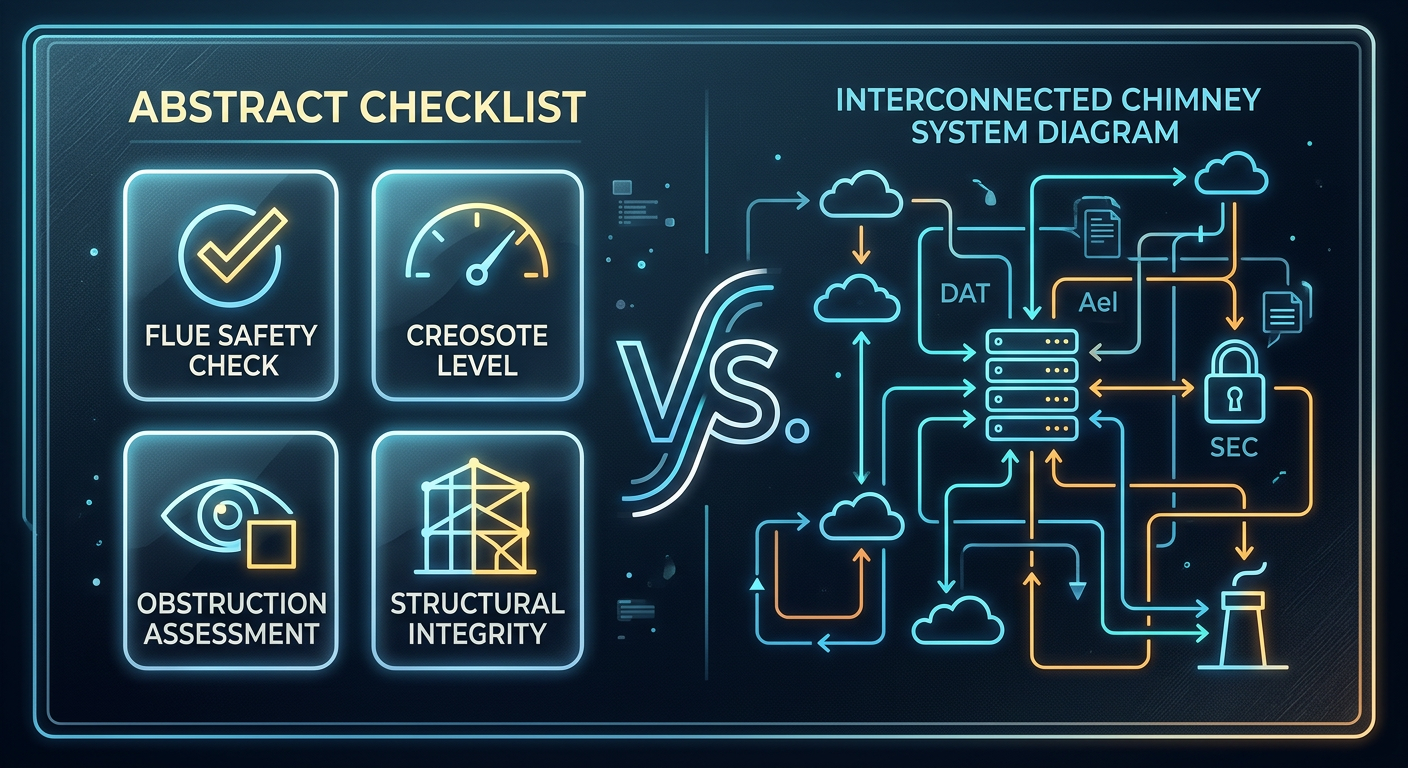
That explanation is convenient, but incomplete.
A Level I inspection is not simply the “short form,” and a Level II inspection is not simply the “long form.” The better distinction is based on why the inspection is being performed and what level of access applies to the system being inspected.
In practical terms, the difference is not just:
“Level I includes these sections, and Level II includes these additional sections.”
The more accurate framework is:
“The inspection level determines the accessibility threshold. The system type determines which sections may apply. The site conditions determine which sections are included, excluded, limited, inaccessible, or not applicable.”
That is a much more technical—and much more defensible—way to understand Level I and Level II chimney inspection reporting.
It also explains why chimney inspection software should not be built as two rigid checklists.
The Common Mistake: Level I Checklist vs. Level II Checklist
Many explanations of chimney inspection levels reduce the distinction to a simple checklist.
That creates problems.
A simplified version often sounds like this:
- Level I: inspect the basic visible fireplace and chimney.
- Level II: inspect more areas, use a camera, and look in attics, basements, and crawlspaces.
There is some practical truth in that, but it misses the controlling logic.
The inspection level is not just a menu of items. It is a scope-and-access framework.
A Level I inspection can include a section that people casually associate with Level II if that section is readily accessible and applicable to the system.
A Level II inspection does not mean every possible component in every possible location is automatically inspected regardless of condition, access, safety, ownership, agreement, construction, concealment, or physical limitation.
The report has to document the real condition:
- included;
- excluded;
- accessible;
- readily accessible;
- inaccessible;
- limited;
- not applicable;
- not inspected;
- further evaluation recommended.
That is more precise than treating Level I and Level II as two prefilled checklists.
The Better Framework: Accessibility Drives the Workflow
The inspection level matters because it changes the applicable degree of access.
A Level I inspection is built around the portions of the system that are within the Level I access threshold. In field terms, that generally means readily accessible areas of the chimney system and applicable accessible portions of the appliance and chimney connection.
A Level II inspection expands the threshold. It includes accessible portions of the system and may require additional access efforts, such as use of common tools, ladders, roof access, attic access, basement access, crawlspace access, and internal image scanning where applicable and possible.
That distinction is important.
The difference between Level I and Level II is not merely that Level II has more boxes. It is that the conditions giving rise to the inspection require a different access expectation.
That changes how the inspector must think.
The inspector is not simply asking:
“Which checklist am I on?”
The inspector is asking:
“Given this system, this inspection level, this reason for inspection, and these site conditions, which sections are applicable and accessible, and which must be documented as excluded, limited, inaccessible, or not applicable?”
That is the workflow InspectionFire is designed to support.
What Triggers the Inspection Level Matters
The reason for the inspection matters on the front end.
Common reasons a Level I inspection may be appropriate include:
- the system is under continued use;
- the appliance and fuel type have not changed;
- no known event has affected the system;
- no known performance concern has been reported;
- the inspection is part of routine annual evaluation;
- the observed conditions do not require escalation to a higher level.
Common reasons a Level II inspection may be appropriate include:
- property sale or transfer;
- appliance replacement;
- fuel change;
- liner installation or relining;
- chimney fire or suspected chimney fire;
- building fire;
- significant weather event;
- seismic event;
- operating malfunction likely to have caused damage;
- system performance concern;
- visible deterioration;
- a Level I inspection is not sufficient to determine serviceability.
The inspection trigger affects the scope because it affects what must be known before the inspector can make a reasonable recommendation.
For example, a fireplace that has been used annually with no change in use may be a different inspection problem than the same fireplace being evaluated during a real estate transfer.
The fireplace did not physically change just because the property is being sold. But the conditions giving rise to the inspection changed. That changes the inspection level and the documentation expectations.
A Level I Inspection Can Include More Than People Assume
One of the biggest misunderstandings is that a Level I inspection only includes a few obvious visible areas.
That is too simplistic.
If a relevant part of the system is within the applicable Level I access threshold and it applies to the system being inspected, it may be inspected and documented during a Level I inspection.
For example, depending on the system and access conditions, a Level I inspection may document:
- fireplace opening;
- firebox;
- hearth and hearth extension;
- damper area;
- smoke chamber areas visible from readily accessible locations;
- cleanout;
- visible connector;
- accessible appliance connection;
- exterior chimney portions visible from readily accessible locations;
- termination components visible from accessible vantage points;
- obvious obstruction or combustible-deposit concerns;
- visible performance or deterioration issues.
The point is not that every Level I inspection includes all of these in every case.
The point is that Level I is not a toy checklist.
A Level I report still needs clear system identification, access notes, observations, limitations, and recommendations.
If the inspector sees a concern during a Level I inspection that cannot be adequately evaluated under the Level I scope, the report should document the concern and recommend escalation or further evaluation.
A Level II Inspection Is Broader, But Not Unlimited
A Level II inspection expands the access threshold, but it still does not mean the inspector can inspect every concealed component of a building.
Level II is broader than Level I, but it is not the same as destructive evaluation.
A Level II inspection may include accessible areas such as:
- accessible chimney exterior;
- accessible chimney interior;
- accessible portions of the appliance;
- accessible portions of the chimney connection;
- accessible attic areas;
- accessible crawlspace areas;
- accessible basement areas;
- roof areas when safely accessible;
- internal flue surfaces by video scanning, image scanning, or similar means where applicable and possible.
But conditions can still limit the inspection.
Examples include:
- unsafe roof access;
- snow, ice, rain, wind, steep pitch, or unsafe ladder placement;
- blocked attic or crawlspace access;
- standing water, confined space, heat, animals, debris, or unsafe entry conditions;
- insert or appliance that cannot be removed within the agreed scope;
- camera blockage from debris, offsets, dimensions, or internal configuration;
- finished surfaces concealing components;
- inaccessible chase interiors;
- missing or unreadable factory-built fireplace labels;
- client-directed exclusions;
- ownership or access limitations in shared structures.
The professional issue is not pretending those limitations do not exist.
The professional issue is documenting them clearly.
A Level II report should state what was accessible, what was not accessible, and how the limitation affects the inspection conclusion.
The Software Problem: Two Rigid Checklists Are Not Enough
If software treats Level I and Level II as two static forms, it can miss the actual logic of the inspection.
A better system-based workflow begins with the system type and then presents the possible sections that may apply.
For example:
- masonry fireplace;
- factory-built fireplace;
- wood stove;
- fireplace insert;
- gas appliance;
- pellet appliance;
- furnace or boiler vent;
- masonry chimney;
- factory-built chimney;
- metal vent;
- multi-flue chimney;
- common chase or structure.
From there, the inspector should determine which sections are included, excluded, limited, inaccessible, or not applicable.
That is different from forcing the inspector through a rigid form that assumes every Level II inspection includes the same exact areas in the same exact way.
A professional form should allow the inspector to say:
- this section applies and was inspected;
- this section applies but was not accessible;
- this section applies but was limited;
- this section does not apply to this system;
- this section was excluded by scope;
- this section requires further evaluation;
- this section could not be inspected safely;
- this section was not readily accessible under the Level I scope;
- this section was not accessible under the Level II scope.
That documentation is the report.
Included, Excluded, Limited, Inaccessible, and Not Applicable
These words matter.
A strong chimney inspection workflow should not treat all skipped sections the same.
Included
The section applied to the system and was inspected within the stated scope.
Example:
“Firebox inspected from the fireplace opening.”
Excluded
The section may have been relevant but was outside the agreed inspection scope or was excluded by client instruction, agreement, or service limitation.
Example:
“Removal of insert excluded from the agreed inspection scope.”
Limited
The section was inspected, but the inspection was restricted by condition, access, visibility, safety, construction, or equipment limitation.
Example:
“Smoke chamber visibility was limited by damper configuration and deposits.”
Inaccessible
The section could not be reached, viewed, entered, opened, or examined under the conditions present.
Example:
“Attic access was blocked by stored contents and was not accessible at the time of inspection.”
Not readily accessible
The section may exist but did not meet the applicable Level I access threshold.
Example:
“Roof-level chimney components were not readily accessible from available safe access points during the Level I inspection.”
Not applicable
The section does not apply to the system being inspected.
Example:
“Combustion air control not applicable to this masonry fireplace configuration.”
These distinctions prevent the report from becoming either vague or misleading.
They also make the final recommendation more defensible.
Camera Evidence Should Follow the Same Logic
Camera use is another area where oversimplification causes confusion.
It is not enough to say:
“Level II equals camera inspection.”
A better statement is:
“Level II includes internal image scanning or similar visual examination where applicable and possible, and any limitation to that examination should be documented.”
That matters because the camera is not the inspection by itself.
The report should document:
- whether internal image scanning was performed;
- what system or flue was scanned;
- whether all applicable flues in the subject chimney were considered;
- whether the scan was complete;
- what limited the scan if it was not complete;
- which images support report findings;
- what recommendations are tied to those images.
A camera can capture evidence, but the reporting workflow determines whether that evidence is useful.
A 360° camera, pan-and-tilt camera, or other inspection camera does not replace the inspector’s professional judgment. It supports documentation of observed conditions and limitations.
The final report still needs to explain what was inspected, what was not, and what action is recommended.
Why This Matters for Home Inspectors
Home inspectors often work near the edge of this issue.
A general home inspection may include readily visible fireplace and chimney observations, but that does not mean the inspector performed a Level II chimney inspection.
This distinction should be communicated clearly.
For home inspectors using a referral model, the report should explain:
- visible conditions observed;
- areas not evaluated;
- whether the flue interior was not scanned;
- whether concealed or inaccessible areas were outside scope;
- why further evaluation is recommended;
- whether the recommendation should occur before use or before closing.
For home inspectors adding chimney inspection services as an ancillary service, the workflow must be more formal.
The inspector needs:
- defined scope;
- appropriate training;
- appropriate equipment;
- camera or image-scanning workflow where applicable;
- system-based forms;
- limitation language;
- evidence capture;
- recommendations tied to findings;
- a report that accurately reflects the inspection level performed.
The problem is not whether a home inspector can add chimney inspections.
The problem is implying that a general home inspection fireplace note is the same as a Level II chimney inspection.
It is not.
Why This Matters for Chimney Companies
Chimney companies can also fall into the static-checklist trap.
A technician may select “Level II” in a report form and assume that label is enough. It is not.
The report should show:
- why Level II was performed;
- which system or systems were included;
- whether all applicable flues in the subject chimney were considered;
- which accessible areas were inspected;
- which areas were inaccessible or limited;
- whether image scanning was completed;
- what findings were observed;
- what recommendations were made;
- what remains unknown because of access or scope limitations.
That is especially important in real estate, insurance, fire loss, legal, repair planning, and dispute-sensitive work.
A Level II inspection report is not stronger because the title says Level II.
It is stronger when the documentation supports the scope.
How InspectionFire Supports an Accessibility-Based Workflow
InspectionFire is built around system-based documentation, not just static checklists.
The software can show the possible sections for the selected type of system and allow the inspector to determine how each section applies to the inspection.
That matters because real inspections are not identical.
A masonry fireplace, factory-built fireplace, wood stove, gas insert, pellet appliance, and furnace vent do not all need the same report structure.
A Level I inspection and a Level II inspection of the same system may involve many of the same possible sections, but the inspection level changes the access threshold and documentation expectations.
InspectionFire supports this more practical workflow by helping inspectors document:
- system type;
- inspection level;
- reason for inspection;
- included sections;
- excluded sections;
- not-applicable sections;
- inaccessible areas;
- limitations;
- photo evidence;
- camera evidence;
- measurements;
- observations;
- recommendations;
- final report output.
The goal is not to force every inspector through every possible section.
The goal is to prevent important sections from being missed or silently skipped.
If a section does not apply, the inspector can mark it as not applicable. If it applies but cannot be inspected, the inspector can mark the limitation. If it is included, the inspector can document the finding.
That is different from a static checklist.
It is a professional inspection workflow.
The Report Should Reflect the Work Actually Performed
A technically sound report should not overstate or understate the inspection.
Avoid vague statements such as:
“Chimney inspected.”
A better report explains:
- which system was inspected;
- what level was performed;
- why that level applied;
- what sections were included;
- what sections were limited;
- what sections were inaccessible;
- what sections were not applicable;
- what evidence was captured;
- what recommendations were made.
For example:
“A Level II inspection was performed due to the transfer of property. Accessible portions of the masonry fireplace, chimney, connected components, accessible attic areas, and flue interior were evaluated where access and conditions allowed. Internal image scanning was limited above the first offset due to flue restrictions. The limitation is noted in the flue section of this report.”
That statement is more useful than a generic checkbox because it explains scope, access, and limitation.
Bottom Line
Level I and Level II chimney inspections are not just two different checklists.
The inspection level is tied to the conditions giving rise to the inspection and the applicable access threshold.
Level I is built around applicable portions within the Level I access threshold.
Level II expands the inspection to applicable accessible portions and typically includes internal image scanning or similar visual examination where applicable and possible.
But in both cases, the report should document reality:
- what applied;
- what was included;
- what was excluded;
- what was readily accessible;
- what was accessible;
- what was inaccessible;
- what was limited;
- what was not applicable;
- what evidence was captured;
- what further action is recommended.
That is why chimney inspection software should not be built as two rigid checklists.
It should be built as a system-based workflow that helps the inspector document scope, access, limitations, observations, and recommendations with technical accuracy.
FAQ
Is a Level II chimney inspection just a longer checklist than Level I?
No. That is an oversimplification. The inspection level changes the accessibility threshold and documentation expectations. The system type and site conditions determine which sections apply, which are included, and which must be excluded, limited, marked inaccessible, or marked not applicable.
What is the main difference between Level I and Level II chimney inspections?
The main difference is not only the number of items inspected. The difference is the condition giving rise to the inspection and the degree of access required. Level I is associated with continued use under the same conditions, while Level II is associated with changed conditions, transfer of property, appliance/liner changes, damage events, or situations where Level I is insufficient.
Can a Level I inspection include areas people associate with Level II?
Yes, if a section is applicable and within the Level I access threshold, it may be inspected and documented during a Level I inspection. The inspection level should not prevent the inspector from documenting relevant readily accessible conditions.
Does Level II mean every possible section is automatically inspected?
No. Level II expands the access threshold, but the inspection is still limited by actual accessibility, safety, physical conditions, ownership/access rights, concealment, agreement, and system configuration. Limitations should be documented.
How should inspection software handle skipped sections?
Skipped sections should not all be treated the same. The software should allow the inspector to identify whether a section was excluded or include it but note whether it was limited, inaccessible, not readily accessible, not applicable, or outside the agreed scope.
Is camera documentation required for every Level II chimney inspection?
A Level II workflow typically includes internal image scanning, video scanning, or comparable visual examination where applicable and possible. If the scan cannot be completed because of access, size, offsets, debris, configuration, or safety limitations, the report should document that limitation.
Why is accessibility important in chimney inspection reports?
Accessibility determines what the inspector can and should evaluate under the selected inspection level. If the report does not document access and limitations, the reader may believe a component was evaluated when it was not.
How does InspectionFire handle Level I and Level II inspection forms?
InspectionFire is designed around system-based workflows. The form can present the possible sections for the selected system type, then allow the inspector to mark each section as included, excluded, limited, inaccessible, or not applicable based on the inspection level, access, and field conditions.