
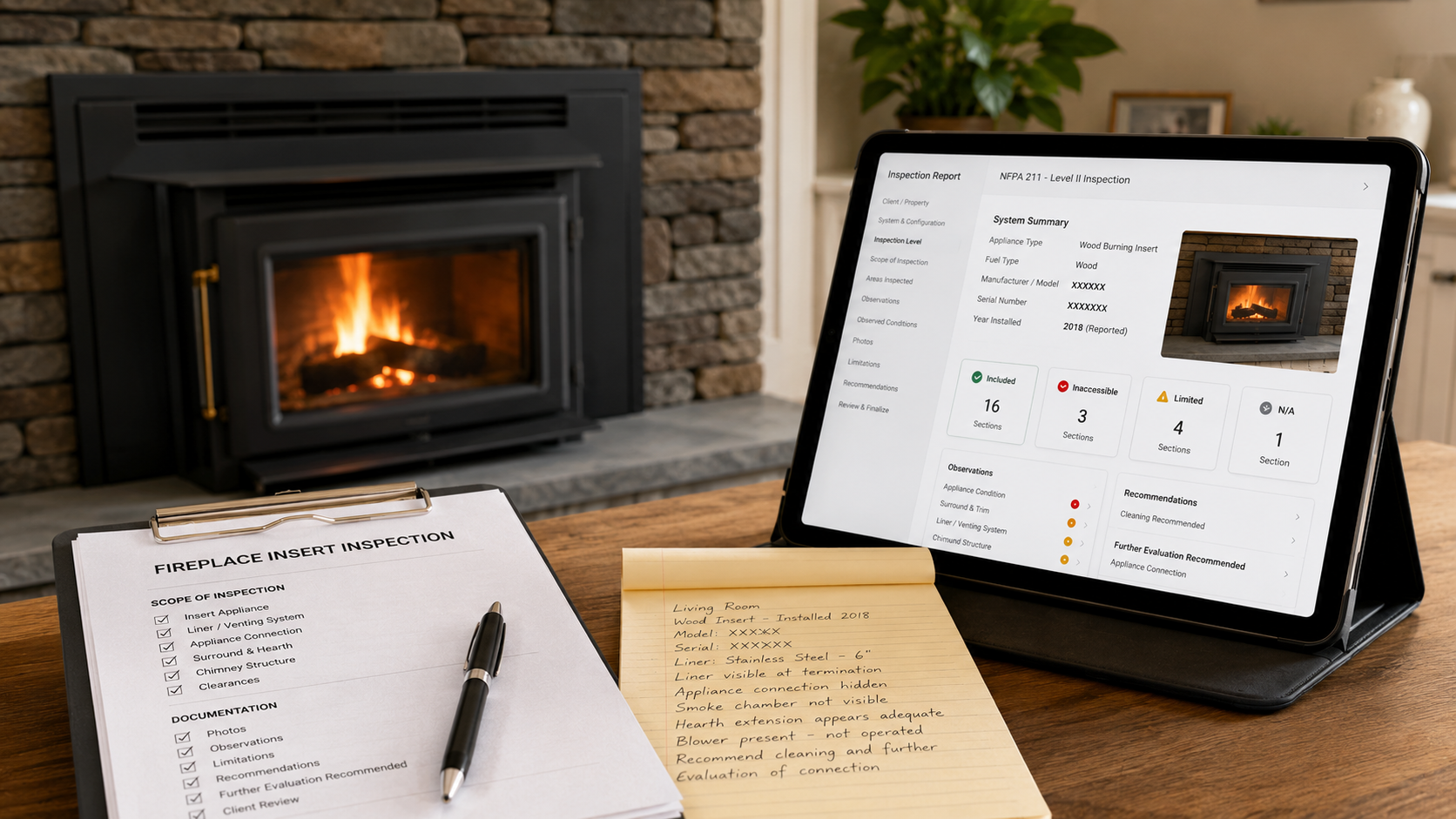
A fireplace insert can make a fireplace inspection look simple.
From the room, the inspector may see an appliance, glass front, surround, controls, trim, and a finished installation. The system may appear neat, contained, and easy to describe.
But a fireplace insert is not just an appliance sitting in a room.
It is an appliance installed into an existing fireplace. That means the report may need to account for several related parts of the system:
- the insert itself;
- the original fireplace;
- the flue or liner serving the insert;
- the appliance connection;
- the visible hearth and surround;
- the chimney structure;
- the accessible attic, crawlspace, basement, chase, and roof areas;
- the manufacturer instructions and listing information that apply to the appliance and venting system;
- the Limitations that affected what could actually be evaluated.
A report that only says “fireplace insert inspected” may not preserve enough of that context.
The better question is:
Did the report document the inserted appliance, the original fireplace, the chimney system for the fireplace and the insert, the connection, and the areas the insert concealed?
That is where fireplace insert inspection software matters.
A Fireplace Insert Can Hide the Original System
One of the main inspection challenges with inserts is visibility.
A fireplace insert may block access to the original firebox, smoke chamber, damper area, hearth details, fireplace opening, smoke shelf, flue entrance, or connector transition. The surround may cover gaps, damaged masonry, altered openings, abandoned components, combustibles, or installation details. The appliance itself may prevent the inspector from seeing how the insert connects to the liner or flue.
That does not mean the inspector did anything wrong.
It means the report needs to document the Limitation.
There is a major difference between:
The original fireplace and smoke chamber were inspected and no reportable Observed Conditions were documented.
and:
The fireplace insert and surround limited visibility of the original fireplace, smoke chamber, damper area, and appliance connection. Those areas were not fully evaluated within the inspection scope.
Those two statements do not mean the same thing.
A report should not make them look the same.
The Insert Is One Part of the System
The insert deserves its own system identity.
The report should attempt to document:
- appliance type;
- fuel type;
- manufacturer;
- model;
- serial number when visible;
- listing or certification label status when visible;
- control location;
- glass/front condition;
- surround condition;
- visible appliance condition;
- visible installation concerns;
- manual availability;
- visible venting or liner information;
- whether the appliance was operated, not operated, or excluded from operation;
- whether the appliance was cool, accessible, and safe to evaluate within the inspection scope.
That information matters.
A gas insert, wood insert, pellet insert, or electric insert may each create a different inspection path. A direct-vent gas insert does not document the same way as a wood-burning insert connected to a stainless liner in a masonry chimney. A pellet insert with mechanical components and venting details does not present the same reporting problem as a decorative electric insert.
The report should preserve what type of appliance was actually inspected.
The Original Fireplace Still Matters
When an insert is installed into an existing fireplace, the original fireplace does not disappear from the inspection record. Generally the original fireplace must be evaluated to determine its suitability to house the installed insert. Sometimes inserts can bypass deficiencies in the original system but often inserts require that the original fireplace systems meet or exceed minimum wood-burning requirements due to lack of testing in improperly constructed or damaged system.
Depending on the scope, the original fireplace may still matter because it may affect:
- clearances;
- hearth support;
- chimney suitability;
- masonry condition;
- smoke chamber condition;
- damper-area modification;
- prior fire damage;
- abandoned openings;
- liner support;
- connector routing;
- combustible material near the opening;
- visible alteration of the fireplace structure.
The report should distinguish between the insert and the original fireplace.
For example:
System: Living Room Wood Fireplace Insert
Host Fireplace: Existing masonry fireplace
Visible Limitation: Insert body and surround limited visibility of the original firebox, damper area, smoke chamber, and liner connection.
That structure is clearer than placing every note under a generic “fireplace” section.
The Liner and Connection Need Separate Documentation
Many fireplace insert inspection problems involve the venting path.
The report may need to document:
- whether a liner was visible;
- liner material when visible;
- liner size when visible or known;
- whether the liner was continuous to the termination where observable;
- connection method at the appliance when visible;
- connector/adaptor visibility;
- cap or termination configuration;
- whether the liner served only the insert or appeared to share the chimney with another opening or appliance;
- whether internal camera inspection of the flue was performed;
- where the internal camera inspection was started;
- whether debris, offsets, appliance geometry, liner size, or access prevented full evaluation.
If the liner or connector could not be evaluated, the report should say so.
A vague statement such as:
Insert venting appears okay.
is weaker than:
A liner was visible at the chimney termination. The appliance-to-liner connection was concealed by the insert and surround and was not verified within the inspection scope. Further Evaluation Recommended if confirmation of the appliance connection is required before use, sale, or repair planning.
That language identifies both the Observation and the Limitation.
Internal Camera Inspection Is Evidence, Not a Guarantee
Internal camera inspection of the flue can be highly useful in insert inspections.
It can help document visible interior liner condition, obstructions, deposits, offsets, damage, corrosion, gaps, abandoned openings, or areas where the camera could not travel.
But the internal camera inspection does not automatically verify every part of the insert installation.
It may not verify:
- concealed clearances;
- the full appliance-to-liner connection;
- hidden adaptor details;
- whether the liner is properly sized for the appliance;
- whether the liner is the correct material for the appliance;
- whether insulation is present where required;
- whether the appliance is listed for that installation;
- whether the insert was installed according to manufacturer instructions;
- whether hidden areas of the host fireplace were modified properly.
A stronger report does not overstate what the camera proved.
It may say:
Internal camera inspection of the flue was performed from the appliance opening where accessible. Visible portions of the liner were documented. The concealed appliance-to-liner connection and hidden installation details were not fully verified.
That is useful, technically careful language.
Level I and Level II Are Not Just Insert Checkboxes
A fireplace insert can appear in either a Level I or Level II context.
The inspection level should be documented based on the reason for inspection, applicable standard, client agreement, and actual access conditions.
A Level I inspection may be appropriate when the system is under continued use with the same appliance and conditions, and the scope is limited to readily accessible portions. A Level II inspection is commonly associated with sale or transfer, appliance changes, relining, or when a Level I inspection is not sufficient to determine serviceability.
But the key point for reporting is this:
The inspection level does not erase the site conditions.
If the insert cannot be removed within the scope, that Limitation should be documented.
If the surround blocks access, that Limitation should be documented.
If the interior liner could not be fully evaluated due to offsets, debris, appliance geometry, or camera travel limitation, that Limitation should be documented.
If attic or crawlspace access was Inaccessible, that should be documented.
A Level II report should not imply that every concealed area was verified if access did not allow it.
When the Insert Cannot Be Removed
Many insert inspections are performed without removing the appliance.
That may be appropriate depending on the scope, safety conditions, tools, time, authorization, manufacturer instructions, gas/electrical connections, physical risk, and whether removal would require work beyond the inspection agreement.
But the report should not ignore the effect of non-removal.
Examples of useful report language:
The fireplace insert was not removed during this inspection. The insert body and surround limited visibility of the original fireplace, damper area, smoke chamber, appliance connection, and lower liner connection.
Further Evaluation Recommended if verification of concealed connector, adaptor, clearance, or host-fireplace conditions is required.
The inspection documented visible and accessible portions only. Concealed installation conditions were not verified.
This is not “negative” reporting.
It is precise reporting.
Nothing to Report Must Be Used Carefully
Nothing to Report should mean the section was Included and observed within the applicable scope, and no reportable Observed Condition was documented.
For fireplace inserts, Nothing to Report should not be used when the accurate status is:
- Inaccessible;
- Excluded;
- Not Applicable;
- limited by the insert body;
- concealed by the surround;
- blocked by the appliance;
- not evaluated because the appliance was not removed;
- unavailable because manufacturer/model information could not be located.
For example, the appliance glass may be visible and have Nothing to Report.
At the same time, the appliance-to-liner connection may be Inaccessible.
Those two conditions can exist in the same inspection.
The report should preserve that distinction.
Home Inspectors Need Clear Insert Referral Language
A general home inspector may observe a fireplace insert during a visual home inspection.
That does not mean the home inspector has verified the liner, appliance connection, installation instructions, concealed clearances, smoke chamber condition, or internal flue condition.
A clear referral statement may say:
A fireplace insert was observed. The insert and surround limited visibility of the original fireplace, smoke chamber, appliance connection, and flue/liner system. This general home inspection did not verify the complete chimney, liner, or insert installation. Further Evaluation Recommended by a qualified chimney/fireplace professional before use or before the end of the inspection contingency period.
That language does not overstate the home inspection.
It gives the client a specific reason for the referral.
Why Fireplace Insert Documentation Matters for Chimney Companies
For chimney companies, insert reports affect more than the PDF.
They affect:
- client understanding;
- office review;
- repair planning;
- liner replacement discussions;
- appliance replacement discussions;
- manufacturer manual research;
- real estate negotiations;
- insurance communication;
- technician follow-up;
- scope control.
If the report does not identify whether the appliance was removed, the office may assume more was inspected than actually was.
If the report does not document the connection as concealed, the client may believe the liner connection was verified.
If the report does not separate the insert from the host fireplace, Recommendations may become confusing.
If the report does not connect internal camera inspection evidence to the correct liner or flue, the visual evidence may lose context.
Good fireplace insert documentation reduces those problems.
What Fireplace Insert Inspection Software Should Support
Fireplace insert inspection report software should support more than a generic “fireplace” note.
It should help document:
- insert appliance identity;
- host fireplace type;
- fuel type;
- manufacturer and model;
- serial number and label status when visible;
- manual availability;
- inspection level;
- reason for inspection;
- operation status;
- Included sections;
- Excluded sections;
- Inaccessible sections;
- Not Applicable sections;
- Limitations;
- Nothing to Report;
- Observations;
- Observed Conditions;
- appliance condition;
- surround and trim condition;
- hearth and visible clearance concerns;
- liner and venting information;
- internal camera inspection of the flue;
- appliance-to-liner connection visibility;
- photos tied to the correct system section;
- Recommendations;
- Further Evaluation Recommended;
- final report review.
The software should not force the inspector to make a false conclusion.
Sometimes the correct professional answer is not “pass” or “fail.”
Sometimes the correct answer is:
The insert was observed, but concealed installation details could not be verified within the inspection scope.
The report needs a place for that.
How InspectionFire Supports Fireplace Insert Documentation
InspectionFire is built for chimney, fireplace, venting, and appliance documentation.
For fireplace inserts, that structure matters because the inspector may need to document the visible appliance, the host fireplace, the liner, the connection, the internal camera inspection evidence, the access Limitations, and the Recommendations in one clear report.
The goal is not just to produce a cleaner PDF.
The goal is to preserve the inspection record accurately.
A fireplace insert should not be reduced to a single checkbox when the system includes an appliance, a connection, a liner or venting path, a chimney, and concealed areas that may or may not have been accessible.
InspectionFire helps keep those pieces connected.
Bottom Line
A fireplace insert inspection report must document more than the appliance.
It should explain what insert was observed, what original fireplace it was installed into, what liner or venting information was visible, what connection details could be evaluated, what areas were Inaccessible or limited, what Observations were documented, and what Recommendations followed.
The report should not imply that concealed areas were verified when they were not.
That is not just better report writing.
It is better professional documentation.
See the Difference. Schedule a Walkthrough.
InspectionFire helps chimney, fireplace, venting, and inspection professionals document fireplace inserts with clearer system identity, internal camera inspection evidence, Limitations, Observations, Recommendations, Nothing to Report, and final report review.
Schedule a walkthrough to see how the workflow supports better fireplace insert inspection documentation.
FAQ
What should a fireplace insert inspection report include?
A fireplace insert inspection report should identify the appliance, fuel type, manufacturer/model when visible, host fireplace, liner or venting system, appliance connection visibility, inspection level, access Limitations, Observations, Observed Conditions, Recommendations, and internal camera inspection evidence where applicable.
Why does a fireplace insert need separate documentation from the original fireplace?
A fireplace insert is an appliance installed into an existing fireplace. The insert may conceal the original firebox, smoke chamber, damper area, connection, liner entry, or other conditions that still matter to the inspection record.
Should a fireplace insert be removed during an inspection?
That depends on the scope, safety, access, appliance type, tools, authorization, and conditions encountered. If the insert is not removed, the report should document what areas were limited or Inaccessible because of the appliance and surround.
Is internal camera inspection enough for a fireplace insert inspection?
No. Internal camera inspection of the flue can document visible interior liner or flue conditions, but it does not automatically verify concealed appliance connections, clearances, adaptor details, liner sizing, manufacturer instructions, or hidden installation conditions.
What does “Further Evaluation Recommended” mean for a fireplace insert?
Further Evaluation Recommended means that a visible condition, missing information, inaccessible area, or concealed installation detail needs additional review before relying on the system for continued use, sale, repair planning, or appliance replacement.
Can a home inspector document a fireplace insert?
Yes, a home inspector can document readily visible portions of a fireplace insert during a general home inspection. The report should not imply that the complete chimney, liner, appliance connection, or concealed installation conditions were evaluated unless that service was specifically included and performed.
What is the biggest reporting mistake with fireplace inserts?
The biggest mistake is treating the insert as the whole system. A useful report should distinguish the appliance, host fireplace, liner or venting path, appliance connection, access Limitations, and Recommendations.
How should Nothing to Report be used in fireplace insert reports?
Nothing to Report should only be used when the section was Included and observed within the applicable scope, and no reportable Observed Condition was documented. It should not be used for areas hidden by the insert, concealed by the surround, Excluded, Inaccessible, or Not Applicable.