
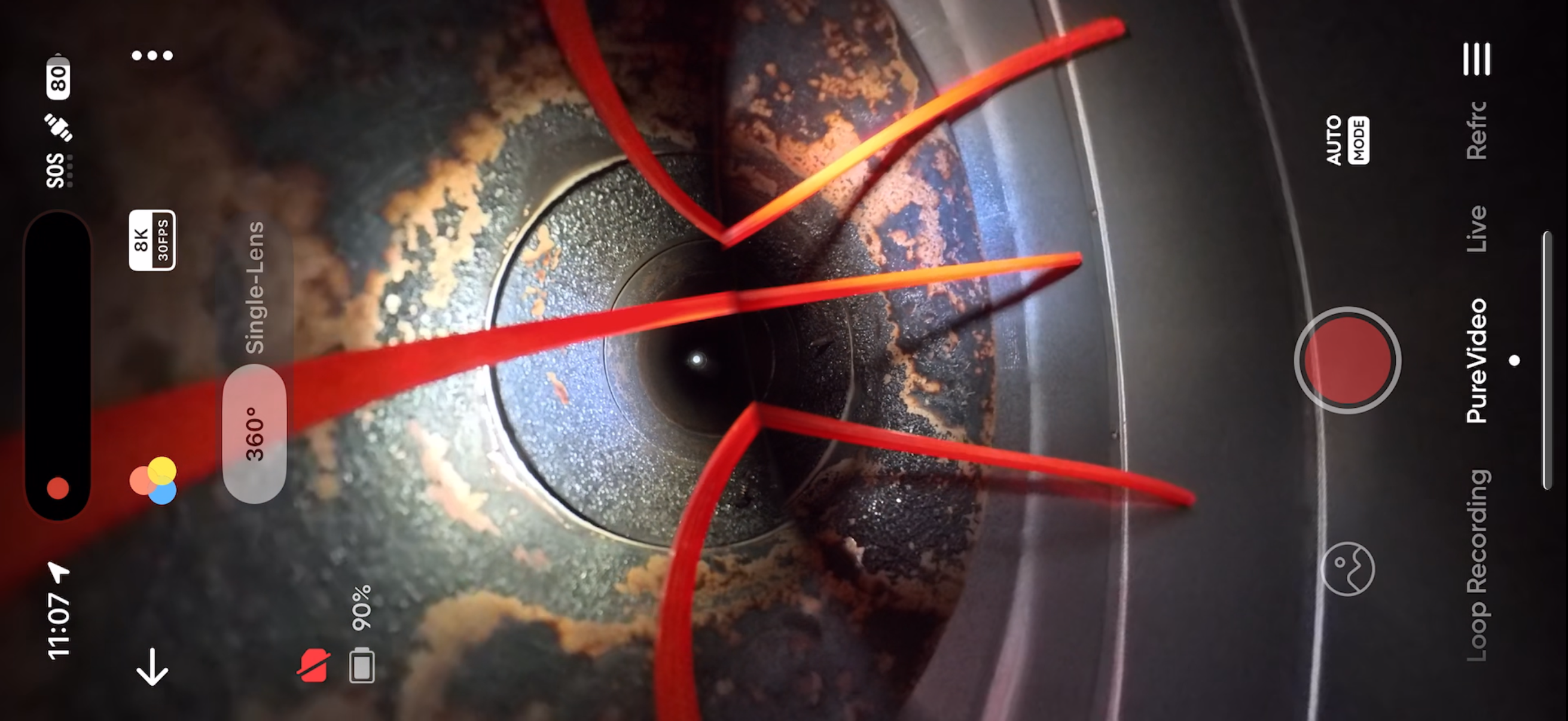
A cheap borescope can be useful around a fireplace, appliance cavity, smoke shelf, cleanout, or other tight-access area. But that does not make it the best primary tool for professional chimney inspection documentation.
For chimney, fireplace, hearth, and venting professionals, the real question is not simply:
“Can this camera see inside the chimney?”
The better question is:
“Can this camera help me produce clear, reviewable, defensible visual evidence for the inspection report?”
That is where the difference between a small borescope and a purpose-built 360° chimney inspection camera workflow becomes important.
The Short Answer
A borescope is a useful utility camera, however it is not specifically suited to run up through a chimney and capture all the necessary data.
A 360° chimney inspection camera is usually a better fit when the goal is broad flue-wall documentation, later report review, and consistent visual evidence.
That does not mean a 360° camera replaces every other inspection tool. It also does not mean a borescope has no place in the truck, or during an inspection. The two tools serve different purposes.
For most professional chimney documentation workflows:
| Need | Better fit |
|---|---|
| Quick look inside a small cavity or other inaccessible area | Borescope |
| Openings too small for larger inspection cameras or phones to fit into or focus on | Borescope |
| Broad interior flue documentation, smoke chamber, smoke shelf, chase interiors with large enough access points | 360° chimney inspection camera |
| Level II-style chimney documentation | 360° camera or other suitable image-scanning system |
| Controlled live directional viewing | 360° camera or pan-and-tilt chimney camera |
| Report evidence that can be reviewed later | 360° camera workflow |
The borescope is a quick-access tool. The 360° chimney camera is a documentation tool.
What a Borescope Does Well
A borescope, endoscope, or small inspection camera can be valuable in chimney and fireplace work when access is limited and the inspection target is narrow.
Examples include:
- looking between gaps/cracks in facing materials or components;
- checking behind or around appliance components;
- looking behind electronics or entering concealed areas using wiring boxes/outlets/etc;
- checking a confined area before disassembly;
- documenting a specific visible concern at close range.
Borescopes are inexpensive, portable, and easy to keep in a service vehicle. Many include their own lights, flexible leads, and phone or monitor connections. For basic troubleshooting and quick verification, they can be useful.
The problem starts when the borescope is treated as the main chimney inspection camera.
Where Borescopes Fall Short in Chimney Inspection Work
Inside a chimney flue, the camera geometry matters.
A small borescope usually points in one direction. If it is dropped or pushed through a flue, the operator may not know exactly which wall surface is being viewed. The camera may rub against one side, twist during movement, or miss portions of the liner. Lighting may be uneven. The image may be unstable. The resulting footage may be difficult to interpret later.
Common limitations include:
- narrow field of view;
- poor orientation control;
- unstable footage;
- lack of perspective;
- limited ability to capture all sides of the flue;
- inconsistent/insufficient lighting;
- limited effective range;
- difficulty documenting vertical position;
- weak reporting workflow;
- limited value for later review by the client, office, supervisor, or third party.
For a quick look, those limitations may be acceptable. For a professional inspection report, they can become a problem.
A report is only as strong as the evidence behind it. If the camera angle is inconsistent, if the footage only shows one wall, or if the image cannot be tied back to a clear inspection location, the camera has not solved the documentation problem.
What a 360° Chimney Inspection Camera Does Differently
A 360° chimney inspection camera captures a much broader visual field than a single-direction borescope. Instead of trying to point the camera perfectly at every wall surface, the camera captures the surrounding flue area for later review.
That changes the workflow.
The inspector can move the camera through the chimney while collecting broader visual evidence. Afterward, the footage can be reviewed to identify areas that need still images, report notes, recommendations, or limitations.
Key advantages include:
- broad flue-wall capture;
- less dependence on perfect camera aiming;
- better reviewability after the inspection;
- stronger visual documentation for the report;
- practical use from the top down or bottom up depending on access and rod setup;
- camera-platform upgradeability when using modern action-camera systems;
- lower cost than many dedicated pan-and-tilt CCTV systems.
A 360° camera does not automatically make the inspection good. The housing, centering, lighting, rod control, camera settings, operator technique, and report workflow still matter. But when those pieces work together, a 360° chimney camera can be one of the most practical documentation tools available to a chimney or fireplace inspection business.
Level II Documentation: The Issue Is Evidence, Not Just Visibility
A Level II chimney inspection is not just a casual look into the firebox.
The inspection scope is broader. It includes accessible portions of the chimney and connected appliance, and the chimney interior must be examined using image scanning equipment or an equivalent or more advanced viewing method where needed to observe those areas.
That matters for camera selection.
The camera should help the inspector document:
- what was visible;
- what was not visible;
- what portions of the system were accessed;
- what limitations affected the inspection;
- whether the flue interior showed visible cracks, gaps, offsets, deterioration, blockage, unused openings, or other concerns;
- which findings were significant enough to include in the report.
For that purpose, a borescope may be too limited as the primary tool. It has its place and may help with a specific detail or getting into an otherwise inaccessible area, but it usually does not provide the same broad documentation value as a 360° chimney camera system or a dedicated chimney inspection camera system.
360° Chimney Camera vs Borescope Comparison
| Category | Borescope / endoscope | 360° chimney inspection camera |
|---|---|---|
| Best use | Quick checks in small areas | Broad flue documentation |
| Field of view | Narrow | Full 360° capture |
| Orientation | Can be difficult to control | Less dependent on perfect aiming |
| Documentation value | Limited for full flue review | Stronger for later review |
| Cost | Usually lower | Usually higher than a borescope but lower than many CCTV systems |
| Report workflow | Often weak | Better suited to photo/video evidence workflows |
| Level II-style use | Supplemental tool | Better primary documentation option |
| Upgrade path | Usually replace the whole unit | Camera can often be replaced or upgraded separately |
| Best buyer | Homeowner, technician, utility use | Chimney/fireplace professional, home inspector adding chimney services |
When a Borescope Is the Right Tool
A borescope still belongs in the inspection toolkit.
Use it when the target is small, close, specific, or otherwise inaccessible. For example, a borescope can help document conditions between components/materials where separation has occurred, inside or behind damaged areas, through cracks/gaps, inside wall cavities, stuck damper area, or behind specific obstruction.
It is especially useful when:
- the area is too small for a larger camera housing;
- the inspection target is near the access point;
- the question is narrow;
- the image does not need to represent the entire flue interior;
- the borescope is supplementing a broader inspection method.
The key is to treat the borescope as a supplemental tool, not as the entire chimney documentation system.
When a 360° Chimney Inspection Camera Is the Better Tool
A 360° chimney camera is the better fit when the goal is to document the chimney interior in a way that can be reviewed later and used in a professional report.
It is especially useful when:
- the inspection involves a Level II-style workflow;
- the company needs consistent photo/video evidence;
- the inspector wants to capture more of the flue wall surface;
- the office or report writer may review the footage later;
- the client needs visual support for recommendations;
- the company wants a portable alternative to a higher-cost dedicated CCTV system;
- the inspector already uses or wants to use action-camera platforms such as GoPro or Insta360.
For many companies, this is the practical middle ground between a cheap borescope and a full dedicated pan-and-tilt inspection system.
Where Pan-and-Tilt Chimney Cameras Still Fit
A 360° camera is not the only professional option.
Traditional pan-and-tilt chimney cameras can be excellent tools. They usually provide controlled live viewing, directional camera movement, a monitor, cable or push-rod system, lighting control, and recording. For inspectors who want live directional control inside the flue, a pan-and-tilt camera may be the right tool.
The tradeoff is usually cost, equipment bulk, and workflow. Dedicated systems can be more expensive and may not integrate as easily with modern action-camera ecosystems or cloud/reporting workflows.
The practical question is not which camera is universally best. The practical question is which camera best supports the type of inspection work your company performs.
Buying Criteria for Professional Chimney Camera Documentation
Before buying a chimney inspection camera, evaluate the system against the workflow you actually need.
Ask:
- Can it document the full area I need to evaluate?
A narrow view may be enough for a small cavity, but not for broad flue documentation. - Can I review the evidence later?
The camera should support report writing, not just live viewing. - Can the footage be converted into useful report photos quickly and easily?
If the footage cannot support clear still images, it may not help the report. - Can the camera move through the chimney without constant snagging?
Housing design, centering, rod control, and durability matter. - Can I document limitations clearly?
If offsets, debris, access restrictions, or geometry prevent complete viewing, the workflow should make that limitation easy to record. - Can the system grow with my company?
A camera-platform-based system may allow future camera upgrades without replacing every part of the inspection setup. - Does it fit the business model?
A company doing occasional visual checks may not need the same system as a company selling documented Level II chimney inspections.
How InspectionFire Fits This Workflow
InspectionFire camera housings and kits are built for chimney, fireplace, hearth, and venting professionals who need practical visual documentation inside real inspection environments.
The purpose is not merely to protect a camera. The purpose is to help the camera move through chimneys and vents in a way that supports usable evidence.
For inspectors using compatible GoPro or Insta360 platforms, InspectionFire systems are designed to support:
- 360° chimney documentation;
- single-lens inspection workflows;
- tight-space and offset navigation;
- low-light inspection needs;
- report evidence collection;
- professional inspection workflows.
A 360° action camera by itself is not a chimney inspection system. The camera needs the right housing, rod setup, lighting approach, inspection technique, and reporting process. InspectionFire focuses on that professional workflow.
Bottom Line
A borescope can be useful. It is not automatically a professional chimney inspection documentation system.
For broad chimney flue review, Level II-style documentation, and report evidence, a 360° chimney inspection camera workflow is usually the stronger choice. It gives the inspector more visual coverage, better reviewability, and a more practical path from field evidence to final report.
Use the borescope for tight, specific, close-range questions.
Use the 360° chimney camera when the inspection requires broader documentation.
And when the report needs to stand on the quality of the evidence, choose the camera workflow accordingly.
FAQ
Is a borescope good enough for a chimney inspection?
A borescope can be useful for quick checks and small-access areas, but it is usually not the best primary tool for professional chimney flue documentation. Its narrow view, orientation issues, and limited reporting workflow can make it weak for broad chimney interior review.
Is a 360° camera better than a borescope for Level II chimney inspections?
For documentation-focused inspections, a 360° chimney camera is generally a better fit than a borescope because it captures more of the flue wall surface and supports later review. A borescope may still be useful as a supplemental tool.
Can a GoPro or Insta360 be used for chimney inspections?
Yes, compatible action cameras can be used as part of a chimney inspection workflow when paired with an appropriate housing, rod setup, lighting strategy, and report process. The camera alone is not enough; the inspection system and workflow matter.
Do I still need a pan-and-tilt chimney camera?
Some companies do. Pan-and-tilt systems are useful when live directional control is the priority. A 360° action-camera workflow is often more practical when broad capture, portability, upgradeability, and later report review are the main priorities.
What should chimney camera footage show?
Useful chimney camera footage should help document accessible interior flue conditions, visible liner surfaces, joints, cracks, gaps, offsets, blockages, deterioration, unused openings, or other relevant conditions. It should also support clear limitations when portions of the system cannot be observed.
What is the biggest mistake when buying a chimney inspection camera?
The biggest mistake is buying only for image capture instead of documentation workflow. A camera must help the inspector produce useful, reviewable evidence for the report. Field of view, movement through the chimney, lighting, camera protection, and reporting process all matter.